Thursday, November 08, 2007

Keeping things in perspective


Life involves struggle. For most people reading this blog, it's far less of a struggle than for the majority of the people on this planet. However, we all have days when life seems particularly difficult.

Here's a simple checklist to help put things in perspective.

- Stop what you're doing.

- If possible, go outside.

- Fill your lungs with air. Slowly breathe out. Repeat.

- Consciously relax your shoulders and neck.

- Assess your situation rationally.

- Focus on the good things in your life.

Of course, this won't make the bad things go away. But it does help to 're-centre' you for the tasks ahead.
------------

Tuesday, November 06, 2007

Kill the apostrophe?


As someone who loves words, this web site made me think...

kill the apostrophe reports: [edited]

"This website is for those who want to remove the apostrophe from the English language, on the basis that it serves only to annoy those who know how it is supposed to be used and to confuse those who dont.

"Many of the calls to defend traditional apostrophe usage are little more than unthinking superstition. Its right because its right, runs the argument, failing to engage with the fact that its arbitrary.

"I suspect a lot of peoples prejudices on this matter are probably inculcated by humiliation at an early age, and leave victims frightened of the terrible social consequences they thereafter imagine will follow from deviating from the standard - this then becomes a self-reinforcing loop as they leap upon other peoples apostrophe 'misuse' like it matters, which it doesnt.

"The fact is that apostrophes are redundant and consume considerable time and resource and wed be better off without em.

"Yes, there are a couple of functional arguments in favour of what the apostrophe does in some limited cases..."

------------

The site is worth a visit, it will either challenge or reinforce your presuppositions!
------------

Thursday, November 01, 2007

Breakfast


50g blueberries
50g raspberries
15g raisins
15g almonds
15g walnuts
1 small apple

Washed down with 100ml apple juice, diluted to 300ml.

About 400 calories, tasty, a good mix of carbohydrate, fat, protein and micronutrients, and surprisingly filling.
------------

Tuesday, October 30, 2007

Just in case


The human body requires a wide range of minerals, vitamins and nutrients if it is to work efficiently. The problem is that no one seems to know exactly what they do, and how much of them we need.

People all over the world live full and healthy lives living on simple, unvaried and unsupplemented diets. However, some cultures have diets deficient in certain essential (Japan's population suffer a high incidence of rickets, a bone condition caused by lack of vitamin D).

I'm not a great lover of fish, or green vegetables. So I supplement my diet with a multi-vitamin tablet and a fish-oil capsule each day. I also know that the fruit I eat has often been chilled during its journey to Waitrose, weakening the vitamin C content. So I swallow a 500mg vitamin C tablet as well.

I have no idea if they do much good. But I do know that I'm getting a regular dosage of stuff that the experts tell me I need.
------------

Thursday, October 25, 2007

Making a difference


Following on from Tuesday's post...

Defeating Global Poverty reports: [edited]

On Tuesday, I participated in a dinner event sponsored by the Seattle International Foundation featuring Nobel Laureate Muhammad Yunus. His talk included these statistics:

- Grameen Bank in Bangladesh is now serving 7.5 million clients (avg. family size of 5 => 35M+ people)

- 27,000 staff

- 80% of poor in Bangladesh are offered microfinance (most poor countries have 5-10%)

- Bank is owned by borrowers

- All capital loaned out comes from savings of the poor (and bank staff)

- Each branch must drive their own savings for capital to loan out and require that each branch become profitable and capital self-sustaining within 1 year

- Microfinance is very empowering for women... often first time in their lives that they have anything of their own. Borrowers (women only) decide who will inherit their savings if they die. Interestingly, most women choose their youngest daughter as she has the least opportunity.

On other Grameen-spawned businesses:

- Grameen Phone is largest mobile operator in Bangladesh with 16M subscribers

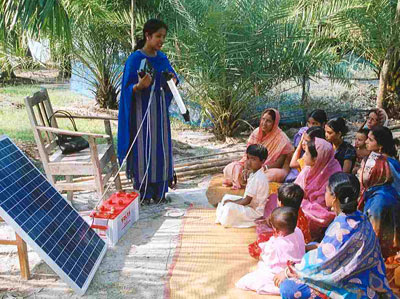
- Grameen Energy is focused on bringing solar energy solutions to the poor... reached 100,000 households so far and now aiming for 1M.

On social businesses:

- Yunus continues to be a strong proponent for social businesses... that is, businesses which exist as commercial entities AND have a mission to have a strong positive social impact

On microfinance in China:

- China has very little supply for microfinance and, next to India, has the largest un-met demand for microfinance

Yunus recently met with senior people in China's central bank on their request to hear about his ideas on microfinance. Central bankers were initially quite defensive ... holding up their cooperative model as being quite effective in channeling financial services to the poor

Yunus said that that was quite interesting and that China must be doing something quite differently as in Bangladesh there was also a long-term cooperative system which was widely promoted by the government, but is completely ineffective due to corruption, bureaucracy and lack of relevance.

This caught the central bank leader off guard and she surprisingly agreed with his assessment and said that they would no longer rely on cooperative model as the cornerstone of China's financial services provision for the poor.
------------

Tuesday, October 23, 2007

Role models #2: Muhammad Yunus


Defeating Global Poverty reports: [edited]

Muhammad Yunus (along with Grameen Bank, which he founded) has been awarded the Nobel Peace Prize for his pioneering work in microcredit. This is a very powerful statement about the power of the microfinance revolution to help alleviate hopeless poverty.

Here are some of the things that impress me about Yunus:

He is an innovator. The Grameen Bank has continued to re-invent itself and lead the way in developing improved products and services which serve the poor AND are sustainable through generating profit.

He is an advocate. Yunus uses his access to powerful people to speak on behalf of the needs of the poor. He continues to frame his ideas, issues and questions in plain language which challenge the typical techno-speak of the international development community.

He is generous. Yunus has generously given of his time, knowledge and influence to help others learn from what they are doing at Grameen Bank in order to implement best practices to help the poor in other areas of the world.

[Editor's note: After receiving the news of the Nobel Prize award, Yunus announced that he would use part of his share of the $1.4 million award money to create a company to make low-cost, high-nutrition food for the poor; while the rest would go toward setting up an eye hospital for the poor in Bangladesh. For a potted history of Muhammad Yunus and the Grameen Bank, visit Wikipedia.]
------------

Thursday, October 18, 2007

Obesity cure discovered


The largest ever UK study into obesity, government-funded and compiled by 250 'experts', has concluded that excess weight is now the norm in our 'obesogenic' [eurrgh!!! Ed.] society.

My favourite quote was this one:

"Individuals can no longer be held responsible for obesity and government must act to stop Britain 'sleepwalking' into a crisis. Dramatic and comprehensive action is required to stop the majority of us becoming obese by 2050."

In fact, I had to check to make sure that this was not a hoax report... 'Individuals can no longer be held responsible...' am I the only one who thinks that's bollocks?

I wonder whether Michael Winner had a hand in the report's release. If not, he couldn't have picked a better time to release his latest book.

In his own words:

"If a fat slob like me, who for decades has resisted everything except temptation, who has no known willpower, who has failed every diet I've ever tried, can lose three and a half stone and keep it off - then there's hope for everyone!"

Having gritted my teeth through his appearance on the increasingly cringeworthy Parkinson show, it sounds as if this 240 page document could be precised into two words.

EAT LESS

And, while I have no love for the star of the Esure ads, he's right.
------------

Tuesday, October 16, 2007

Healthy heels and elbows


As we age, our skin gradually loses its elasticity. I've never been one to 'bother' with any kind of moisturising regime, but as I entered my forties, I noticed that I was developing 'elephant elbows'. The skin was becoming very dry, with a tendency to crack and (eughh) bleed. And my heels were heading the same way.

My good friend Emma recommended I try Body Shop's Hemp Hand Protector cream. I did, and it has worked a treat.

Applying a small quantity of it to my elbows and heels after each gym session seems to replace the moisture that my aging body is no longer providing, leaving them pliable and crack-free. Hurrah!
------------

Thursday, October 11, 2007

Watch your mouth


The five main steps in maintaining good oral hygiene are:

Flossing (at least once a day)
Done properly this will remove the plaque and particles of food between your teeth, and under the gumline. If you're not sure how to floss properly, a quick Google will provide hundreds of sites eager to show you how.

Tooth Brushing (at least once a day)
Electric toothbrushes have come down a lot in price over the past couple of years, and while there's no proof that they're more efficient than 'manual' versions, the fact they require less effort does encourage you to spend more time on making sure your teeth are properly scrubbed. Again, Google will reveal plenty of info on brushing techniques.

Tongue Scraping (at least once a day)
Tongue-borne bacteria is the major cause of bad-breath. It can be scraped off using your toothbrush, or a purpose-made tongue scraping device. Be prepared to fight the gag-reflex, and make sure you go back as far as you can, as this is where the really 'orrible bugs reside.

Nutrition
OK, you know about avoiding sugary stuff, especially sugary stuff that will stay in your mouth a long time (boiled sweets, mints, Werthers Originals). Drink water after eating sweets to dilute/rinse the nasties. Hard toffee is excellent for removing fillings/ceramic crowns from their mountings.

Regular check-ups
Visit a dentist at least once a year whether you think you need to or not. They can spot stuff going wrong before it becomes painful/even more expensive.
------------

Tuesday, October 09, 2007

Teeth


Human teeth are composed of:

Enamel
Enamel is the hardest and most highly mineralized substance of the body. 96% of enamel consists of minerals, primarily hydroxyapatite (crystalline calcium phosphate). Enamel varies in thickness, up to 2.5mm.

Dentin
Supporting the enamel and forming the majority of the tooth, this porous, yellow-hued material is a mineralised tissue with an organic matrix of collagenous proteins. It accounts for the majority of the structure of the tooth.

Cementum
Cementum is a bony substance covering the root of a tooth. It is composed of 45% inorganic material (mainly hydroxyapatite), 33% organic material (mainly collagen) and water.

Pulp
The dental pulp occupies the central part of the tooth. It consists of blood vessels and nerves, entering the tooth at the apex of the root. Along the border between the dentin and the pulp are odontoblasts, which initiate the formation of dentin. The pulp is what most people call 'the nerve' of the tooth. And yes, it's the bit that is sensitive to pressure and temperature.

Information via Wikipedia
------------